 Translate
Translate
Translate


|
||||
No advisories are currently in effect for the Front Range Urban Corridor from Douglas County north to Larimer and Weld counties, including the Denver-Boulder area, Fort Collins and Greeley.
For statewide conditions, forecasts and advisories, visit:
https://www.colorado.gov/airquality/colorado_summary.aspx
At 1PM (MST), Tuesday, 10/13/2026 the highest AQI value was 56 for Particulate less than 10 micrometers which indicates Moderate air quality. Respiratory symptoms possible in unusually sensitive individuals, possible aggravation of heart or lung disease in people with cardiopulmonary disease and older adults. Unusually sensitive people should consider reducing prolonged or heavy exertion.
The Colorado Department of Public Health and Environment and the Regional Air Quality Council's Summer 2026 Ozone Action Day Alert Program has concluded. The winter High Pollution Advisory Program begins on November 1. Air Quality Action Days or advisories for ozone for other pollutants, however, will be issued as needed at any time during the year and reported on this web page.
The Air Pollution Control Division's Winter 2026/2027 High Pollution Advisory Program will begin November 1. Thank you for your interest in and support for efforts to improve air quality for the citizens of the Denver- metro area.
 |
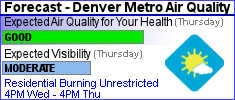
| FRONT RANGE AIR QUALITY FORECAST: Tuesday, October 13, 2026, 2:05 PM MDT Ozone concentrations are expected to be in the Good category on Tuesday and Wednesday. Fine Particulate Matter concentrations are expected to be in the Good category on Tuesday and Wednesday. Carbon Monoxide concentrations are expected to be in the Good category on Tuesday and Wednesday. Nitrogen Dioxide concentrations are expected to be in the Good category on Tuesday and Wednesday. Visibility is expected to be Weather Excluded on Wednesday, due to high relative humidity and rain showers.COLORADO SMOKE OUTLOOK: Thursday, July 11, 2024, 8:40 AM MDT Smoke from out-of-state fires will begin affect northern Colorado by late Thursday morning, and is expected to continue spreading eastward as the day goes on. The majority of smoke will remain in the upper atmosphere, although some will mix down to the surface. Hazy skies are likely across much of northern and western Colorado. Light to moderate smoke is possible Thursday in northwest Colorado, especially Steamboat Springs, Craig, and Meeker. No major public health impacts are expected due to smoke (fine particulates), however unusually sensitive people, should consider reducing prolonged or heavy exertion on Thursday. Light to moderate concentrations of smoke are also possible near small wildfires and prescribed burns around the state. What if there is a wildfire or smoke in your area? The focus of the Colorado Smoke Outlook is on large fires (e.g., greater than 100 acres in size). Nevertheless, smoke from smaller fires, prescribed fires, and/or smoke from new fires not yet known to CDPHE air quality meteorologists may cause locally heavy smoke. If there is smoke in your neighborhood, see the public health recommendations below. Public health recommendations for areas affected by smoke: If smoke is thick or becomes thick in your neighborhood you may want to remain indoors. This is especially true for those with heart disease, respiratory illnesses, the very young, and the elderly. Consider limiting outdoor activity when moderate to heavy smoke is present. Consider relocating temporarily if smoke is present indoors and is making you ill. To temporarily relocate to an area with better air quality, consider using this map (https://fire.airnow.gov/) to identify the best area closest to you. IF VISIBILITY IS LESS THAN 5 MILES IN SMOKE IN YOUR NEIGHBORHOOD, SMOKE HAS REACHED LEVELS THAT ARE UNHEALTHY. |
|
WHAT IS AN ACTION DAY?: An Action Day for fine particulate matter, carbon monoxide, ozone or other pollutants indicates that either current air quality is unhealthy or conditions are expected to worsen later in the day or on the next day. Action Days for air pollutants generally indicate that air quality will be in either the Unhealthy or Unhealthy-for-Sensitive-Groups categories according to the Air Quality Index. Action Days always convey overarching public health recommendations, and, according to season, trigger a variety of mandatory and voluntary pollution prevention measures. For example, during the summer open burning is prohibited when an Action Day for ozone and/or fine particulates is in effect. During the winter, residential burning restrictions are in effect when an Action Day for Visibility is in effect.
For a detailed description of both the AIR QUALITY INDEX and the VISIBILITY STANDARD INDEX please visit https://www.colorado.gov/airquality/brochure.aspx
COLORADO OPEN BURN FORECAST:
For those with permits for open burning, that is the burning of waste materials or vegetation outside, check the following webpage to find out if open burning is allowed today. Keep in mind that open burning is prohibited when an Action Day is in effect:
https://www.colorado.gov/airquality/burn_forecast.aspx
FOR CURRENT FRONT RANGE ACTION DAYS/ADVISORIES:
https://www.colorado.gov/airquality/advisory.aspx
FOR CURRENT AIR QUALITY CONDITIONS STATEWIDE:
https://www.colorado.gov/airquality/air_quality.aspx
SOCIAL MEDIA:
https://www.facebook.com/cdphe.apcd
https://twitter.com/cdpheapcd
AIR QUALITY NOTIFICATIONS:
https://www.colorado.gov/airquality/request_alerts.aspx(CDPHE automated e-mail alerts)
http://www.enviroflash.info/signup.cfm(CDPHE forecasts via automated e-mails from the EPA)
|
The Winter High Pollution Advisory Program is coordinated by the Air Pollution Control Division of the Colorado Department of Public Health and Environment.
Winter season air pollution forecasts are issued daily from October 31 through March 31 at 4 p.m. When conditions warrant, forecasts will include information about Action Days and subsequent indoor burning restrictions.
An Action Day for fine particulates, carbon monoxide or ozone indicates that either current air quality is unhealthy or conditions are expected to worsen later in the day or on the next day. Action Days for air pollutants generally indicate that air quality will be in either the Unhealthy or Unhealthy-for-Sensitive-Groups categories according to the Air Quality Index. Action Days trigger mandatory restrictions that limit indoor burning to approved devices only, voluntary driving reductions, and public health recommendations.
An Action Day for Visibility alone indicates that the Visibility Standard Index for visual air quality is expected to be poor on the current or following day. An Action Day for Visibility will trigger mandatory restrictions on indoor burning and voluntary driving reductions for the seven-county Denver-Boulder metropolitan area only.
When no advisories are issued, air quality is good or moderate and is expected to remain so during the effective period of the forecast. No restrictions are in place.
|
Ground-level ozone is an air pollution problem that impacts the health of all Coloradans. Exposure can cause acute respiratory problems and trigger asthma attacks. During Ozone Action Alerts, avoid rigorous outdoor activity during the heat of the day. Prolonged exposure can cause long-lasting damage to your lungs.
You CAN make a difference by doing your part to improve air quality along Denver's Front Range. Even during periods of wildfire smoke, reducing your personal emissions can help decrease ozone production. Combining or skipping just two car trips a week has a positive impact on our air quality. Find other easy solutions that fit your lifestyle from Simple Steps. Better Air. (http://www.SimpleStepsBetterAir.org), a program of the Regional Air Quality Council.


 Forecasts & Monitoring